
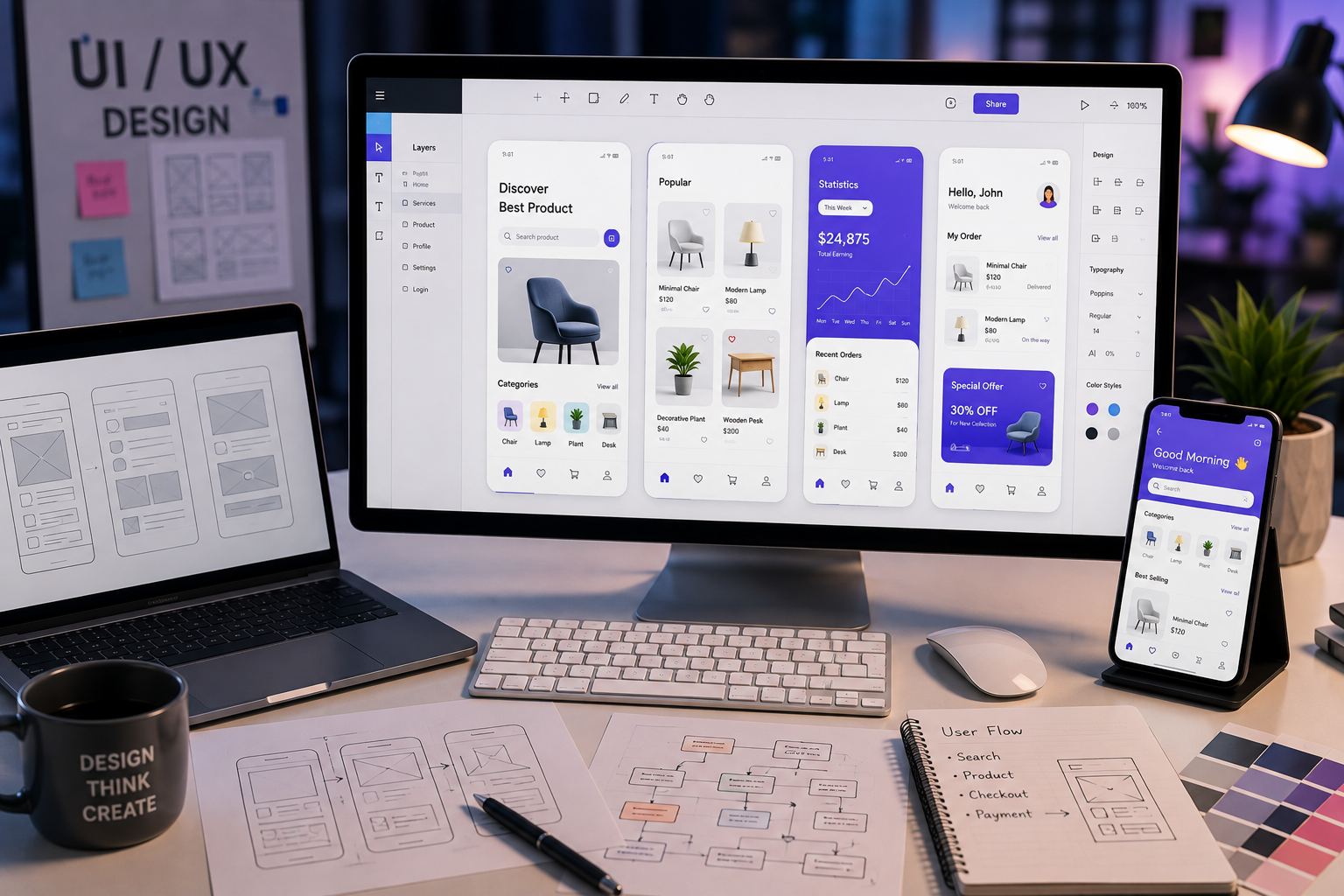
Intuitive Design. Seamless User Experiences.
UI/UX Design is about creating digital experiences that are not only visually appealing
but also simple, logical, and effortless to use. A strong interface should help users
understand where they are, what they can do, and how to reach their goal without confusion
or unnecessary friction. Our UI/UX approach combines user research, competitor analysis,
information architecture, user journeys, wireframes, visual design, interaction patterns,
responsive layouts, hierarchy, accessibility considerations, and conversion-focused
thinking. We begin by understanding your audience, business goals, digital product,
customer expectations, and the actions users should be encouraged to take. From there,
we structure content and navigation around real user needs rather than designing purely
for appearance.
Visual elements such as typography, spacing, imagery, icons, buttons,
cards, forms, and interactive components are carefully organized to create consistency
across the interface. We also consider how the experience adapts across desktop, tablet,
and mobile screens so interactions remain clear and comfortable on every device. Whether
we are designing a corporate website, business portal, landing page, ecommerce experience,
dashboard, or custom digital platform, the objective remains the same: create an interface
that feels natural to use, supports your brand identity, reduces friction, and helps turn
visitors into engaged users, enquiries, leads, or customers.
Contact Us
Our UI/UX process combines user understanding, information architecture, interface design, and usability refinement to create clear and engaging digital experiences.
01
Research & UX Strategy
We study your users, goals,
competitors, journeys and existing
experience to identify opportunities.
02
Wireframe & UI Design
We create page structures, flows,
responsive layouts and polished
interfaces aligned with your brand.
03
Test & Refine
We review usability, interactions
and responsive behaviour while
refining the final experience.
Turn complex digital journeys into clear, intuitive experiences that help users understand, engage, and take action with confidence.
Good UI/UX design removes unnecessary effort from the user journey. Every page, section,
button, form, menu, and interaction should support a clear purpose rather than adding
visual complexity. We map how users move through a website or digital platform and identify
the points where confusion, hesitation, or friction may occur. Information architecture
helps organize pages and content logically, while wireframes establish hierarchy before
detailed visual design begins. Once the structure is clear, interface design brings the
experience to life through typography, layout systems, spacing, imagery, icons, color,
buttons, cards, forms, and interaction patterns that reflect your brand. Responsive behaviour
is planned from the beginning so the interface remains usable across varying screen sizes
instead of simply shrinking a desktop layout.
We also consider form usability, navigation
clarity, content readability, visual contrast, calls to action, user feedback states, and
consistency between different pages or modules. For business portals and dashboards, the
focus may include simplifying large amounts of information and making important actions
easy to access. For ecommerce experiences, user journeys may be optimized around product
discovery, comparison, trust, and checkout progression. For service websites and landing
pages, design can guide visitors toward enquiries and conversions without overwhelming them.
UI/UX also works closely with website development, branding, SEO, content, and conversion
strategy because a strong user experience supports nearly every aspect of digital
performance. By combining usability, visual clarity, audience understanding, responsive
thinking, and business objectives, we create digital interfaces that feel polished,
intentional, and genuinely easier for people to use.
Questions & Answers
UI/UX design insights & frequently
asked questions